
riving isn’t an immediately appealing mode of transport in Egypt. For starters, it's pretty dangerous with the injury rate being more than ten percent more than the global average, and everyday knocks and bashes are so commonplace that they aren't even recorded. My friend said to me that rather than “Mirror; Signal; Manoeuvre”, what Egyptians practice is “Beep; Flash; Undertake”. What’s more, cars are more expensive than in the West due to steep registration fees and import tariffs. The cheapest we could find was a 1983 Nasser (Fiat) 127, for over 1500GBP. Coupled with the masses of paperwork required and insurance, it just didn't seem worth it.
However, when the Egyptian government increases tourist train fares to 60$ for a third class return for a three-hour journey (more expensive than almost every train in Europe) and delays the opening of the Cairo Monorail by another year, you can only take so many microbuses before your patience runs out. The idea of driving reenters the fray. Instead of buying outright, why not rent a car? They're always in far better condition than the ones bought second hand, and almost all of the paperwork is done for you. Open the SIXT app, and you’ll find several attractive rental offers, particularly the latest Subaru Impreza for just £30 a day - perfect for a boys’ trip to Marsa Alam.
That’s the car sorted, but with current political situation in Egypt, particularly in Sinai and the Saïd, the roads have several checkpoints and tolls between cities, so your work is far from complete. Non-Arab state licenses aren’t valid here, so you'll need something to supplement the one from your home country. Many have told me driving around Cairo, they haven’t been inspected once; but outside of zahmah Cairo, traffic officers usually have more time on their hands, and are less willing to compromise with foreigners, whom they will almost automatically perceive as tourists. The scene of a group of boisterous, sunburnt Europeans pulling up in a shiny Japanese sports car to a checkpoint in the middle of the desert, will raise even the most ghafil traffic officers’ eyebrows. Egyptians love nothing more than inspecting your documents, even if it isn’t in their official remit, so a car full of foreigners with the wrong paperwork would be like Christmas. For a hassle-free journey and to avoid paying excessive bakshish, you therefore have two options:
In this article, I’ll explain how I did the latter. All in all, it took me about eight painstaking visits to the office, just to have my application rejected the first time. Nevertheless, several more visits later I am happy to say I finally got my hands on one. Nothing of use was written online; had there simply been a page explaining the process, I'd have likely been able to get this done in a single day. I therefore hope this article might supplement this shortcoming of the Egyptian transport ministry and save my fellow expats some valuable time.
If you’ve been through the purgatory at the Abbasiya Passports Unit (or the equivalent in your chosen governorate), then you’ll know about the importance of making copies. Print copies (black and white is fine) of:

If you don’t have a printer, you’ll find a copy shop at the office in Cairo (more on that later), though there also are plenty in and amongst the streets. Important: The officer will want to check your physical documents at the office, so bring them with you as well!
You won't need to pay for the license today, but bring about 100EGP (which should be more than enough) for the copying and travelling. Bring a pen as well for the paperwork.
The Egyptian traffic directorate has offices everywhere, but it is important you go to the right one. I tried several places in New Cairo and the surrounding area, each time in vain. For foreigners, the only place to go in Cairo (that I know of) is in Boulaq, about a thirty-minute walk from Orabi metro station in the direction of the Nile; grab a tuk-tuk if you can, the fare should be no more than 50EGP. The office's name isn’t written in English, but in Arabic it is وحدة مرور وتراخيص الجزيرة (which translates to ‘Traffic & Licensing Unit Gazirah’); it should come up in Uber, InDrive and Google Maps.
Pro-tip: Get there early in the morning. The working hours are officially from 8am-3pm. If you know you'll arrive outside of the hours, don't bother making the trip and delay it for tomorrow; you'll only be told the same thing by security.
At the Google Maps location, you’ll find a covered road on the right (facing the Nile), looking onto a large door, which is rarely open. Walk up to it, and you’ll find a smaller opening on the left, with an officer ready to inspect your physical documents and ask your purpose. For those not comfortable in Arabic, tell them you’re looking for a rukhsa agnabiyya.
You’ll be shown into the yard behind the gate. On the right, in a rather ramshackle building next to the coffee shop, there is a copy shop where two cheery Egyptians can make copies of your documents for a small fee. If you haven’t already, get that done before entering the main building to save time and confusion.
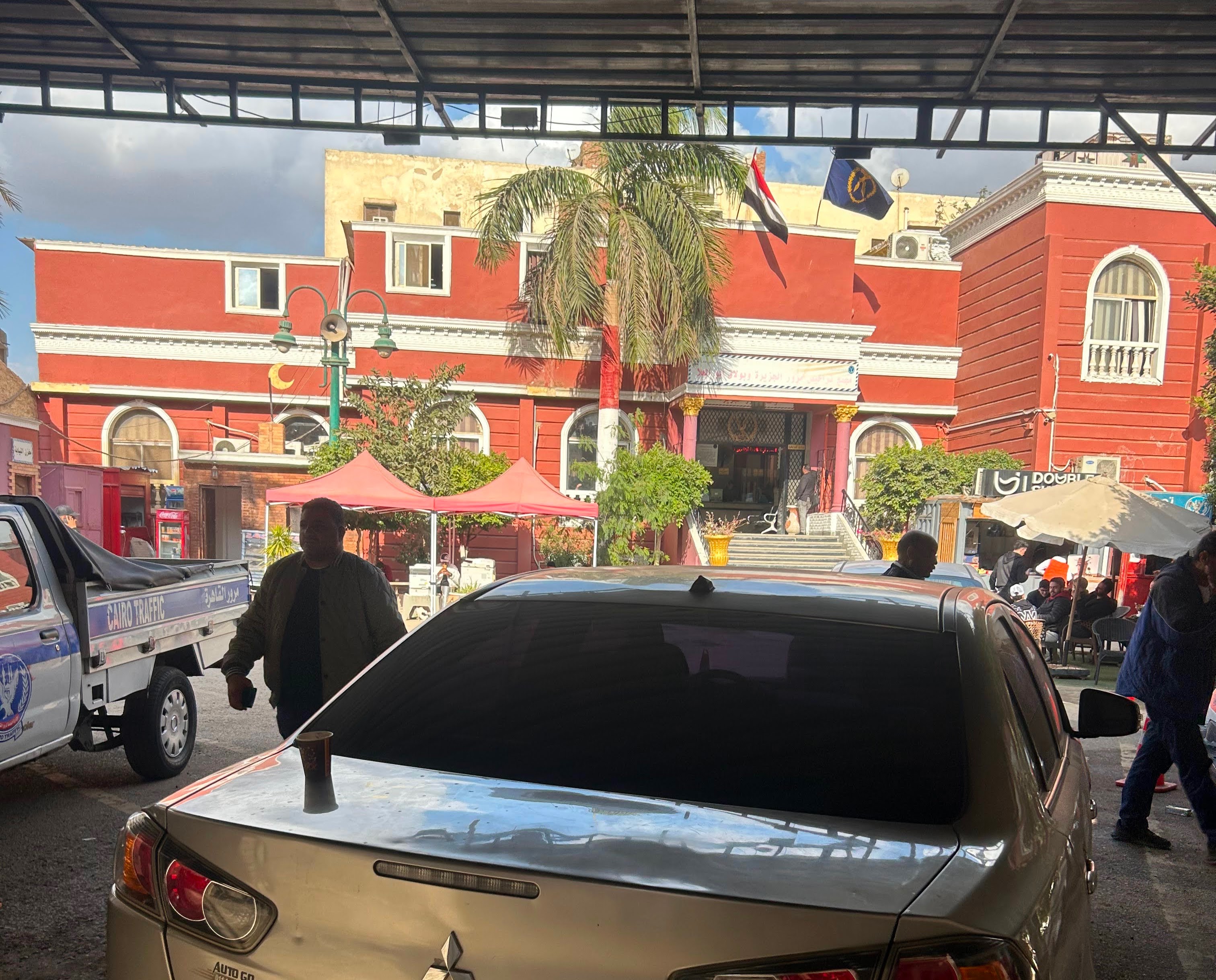
Head inside the large red building (in the colours of the Egyptian flag) and to the desks on the right; there’ll be a counter signposted in English for foreign applications. Ignore the instructions on the sign, just try to hover around and speak to someone behind the counter when they appear. For at least one stage, you'll have to wait; even if the person supposed to be helping you is free and is staring at the wall, looking bored, that'll be them taking a break. They haven't forgotten about you - don't worry or panic, and have patience: they'll have it done for you by the end of the day.
The person behind the counter will ask for your documents (physical and printed) and will then scribble on a piece of paper. Take that to the copy shop, where you'll be handed a form on which to write your details (address, telephone, passport number, etc.). If there's one think I've learned from living in Egypt, is that there's always a form. It’s entirely in Arabic, so the office will usually do it for you if you take it back inside.
Now for the piece de resistance: the person behind the counter will point to the office on the left, in which sits the mudir who you must ask for the crucial stamp on your form. If he’s in a good mood, he’ll give it to you no questions asked, but occasionally it’ll warrant an inspection of your entire application. After that’s done, take your form back to the counter.
That’s it! Come back in a week to pick up your shiny new license. They won’t hold onto your physical documents; you can take them home with you, along with the excitement that you will be soon able to drive in Egypt.
This is it - the day you pick up your license. Just because this is the final step, don't think it'll be anything trivial. The steps before were aimed at ensuring that your application is accepted; today is when you'll work through the health tests and other miscellaneous tasks required to generate the license itself. There aren't any more copies to make, thankfully, but you'll need the following:
Go to the usual counter if you haven’t already been recognised by one of the members of staff. They’ll remember you, but will ask for your residency permit anyway. If they tell you rafad, you’re in bad luck, because your application has been rejected centrally. If not, you can begin the process of generating your physical license. Give your usual documents and passport photos to the officer. The process will now involve a lot of following them around, them disappearing and telling you to sit down, and then coming back about ten minutes later with a new piece of paper.
By now, you should have noticed that the officers have become friendlier. When you first ask them to help you, they are often pretty unapproachable. Yet working together through Egypt’s complicated bureaucracy builds friendship in the most remarkable of ways. I remember the final day I was at the office; I stood outside chatting with security for a good twenty minutes, smoking with them and learning their different alqaab (Egyptian nicknames) for each other. I had been there so many times, half the staff knew my name, I had several new WhatsApp contacts and a few ‘azuumaat marikbia to eat at the security officers’ family homes.
One of the first things they’ll do, is call you into the office and sit you in front of a computer monitor with a camera attached to it. I hope you don’t look too dishevelled from waking up early (I certainly did), because this is when they’ll take your photo to go on the card. The passport photos you brought will have disappeared at this point, as these are for the office’s own records.
If you’re comfortable enough in Arabic, tell them you’ll wait outside in the yard. The chairs inside are uncomfortable, it’s stuffy, dingy, chaotic, and not a pleasant place to be in for more ten minutes.
I was sat down in there once, mindlessly passing the time, when my lapse in concentration was shattered by a man sat a few seats away jumping up in fright and looking at the floor. The same then happened with the man on the row in front, and several times more, until half the room was on their feet. Then, just next to my leg, I felt a rush of wind, and saw a tiny, brown creature zip past me; it was unmistakeably a large, Cairo spiny mouse. Its cover blown, it ran around the room, in front of the counters, causing mayhem and exciting even the most downbeat clientele. That was until the mudir, clearly having heard the commotion, stepped out of his office, waited until the mouse ran past him, and booted it through the air, in the direction of the basement. The room returned to normal quicker than the chaos had begun.
You’ll be told to go upstairs and get a blood and eyesight test in a clinical room built on the roof; in it sit two very calm, friendly, and straightforward women. It feels rather like an oasis from the very masculine, suffocating atmosphere downstairs. Go back to where your officer, and you’ll likely have to wait a little longer while your license is being made.
The officer will likely mention money towards the end of the process. The price for foreigners is, as you might expect, higher than the average for Egyptians, so they will often lower their voice; you should do the same. It’s about half the average monthly salary in Egypt, so it’s better for everyone if you don’t shout about it.
As you might have guessed, this is also because the staff expect, as they do from everyone, a little bit more money for their time. When I discussed it with an Egyptian friend afterwards, he explained to me that asking foreigners for bakshish would have far greater repercussions, as the implication is one of manipulating tourists compared to locals following their taqalid. If you do agree a little extra, they’ll ask you several times to keep it quiet.
Of course, legally speaking, I wouldn’t condone paying alms or bribes. That said, the advice (which is not necessarily based on my own experience) I would give is that the amount extra isn’t necessarily important, but the offer you initially make is what they will expect from you when it is time to pay, so start conservatively. Bakshish is as much a cultural phenomenon as it is economic; it’s a gesture of gratitude, and an acknowledgement of hierarchy, originating from Pharaonic gifts, Ottoman bureaucracy, Islamic traditions of charity, and Indian concept of bhiksha imported by the British. At the end of the day, you can only give them what is in your pocket; so, if you do pay, try and moderate how much extra you have on you!
Once you come to an agreement, you will have crossed the final hurdle. Wait a little longer, before being called one more time to exchange the money for the license. You’ll stride out of the yard, card in hand, possibly showing it gleefully to the man on the door. You won’t be back again, unless you’re still here after a decade after which the card will need renewing. You can expect that I’ll have written the guide on how to do it by that time.
The feeling of having finally completed a four month long bureaucratic journey is indescribable. I went about eight times to that office in total, in addition to the three other traffic offices I visited just to find that they weren’t of use.
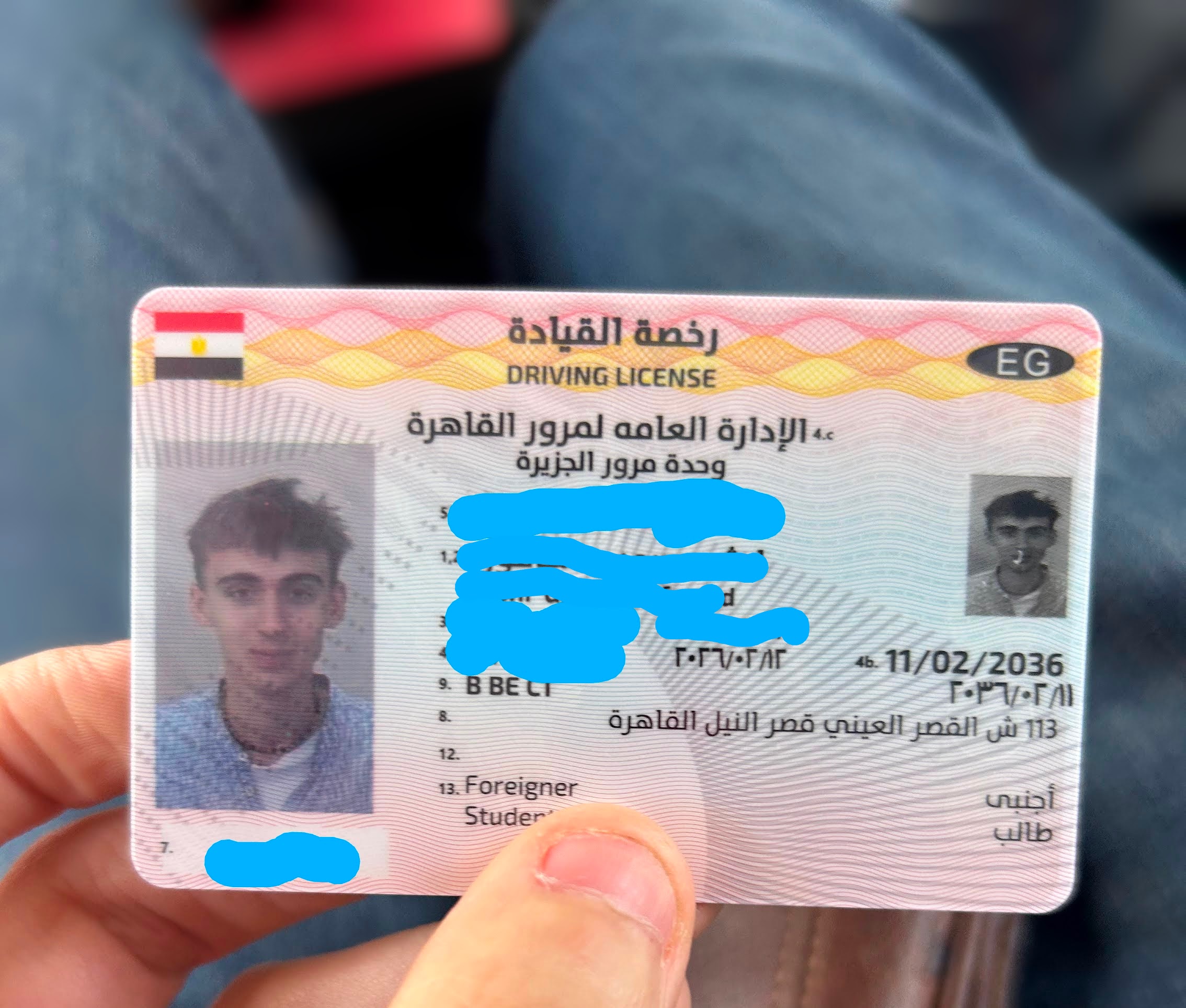
I have no doubt that despite this guide, you too will face similar trials and tribulations, as the process is bound to change immediately after this is written. It’s hard to tell whether what I’ve outlined here is truly official; in some places, particularly when it comes to paying, it seems pretty opaque. My final piece of advice is the most important, yet the most abstract: treat the staff respectfully and try to bond with them. They’re generally good people, working in an environment that requires a lot and compensates little. Don’t be afraid to stand your ground, or argue, especially if you’re British (like me) and are used to shirking confrontation; but at the end of the day, deliberately booming patronisingly simple requests with a faux patience in a foreign language, as I’ve seen many tourists do, is never the solution.
That wasn’t too bad, right? Once it’s written down, the process becomes easier than even its equivalent in our home countries. I once believed that foreigners had it difficult in Egypt with the bureaucracy required for our residency permits etc.; that was until I saw what Egyptians themselves must go through. Moving around the yard are regular masreen with masses of paperwork, usually inside thick booklets, which they must complete simply to renew their license. That one sheet of paper, which you (hopefully) didn’t even have to fill in, pales in comparison. In truth, we expats generally have it quite good here.